Victoria Falls Bridge
The Victoria Falls Bridge was conceived by Cecil Rhodes, who allegedly stated: “construct the Bridge across the Zambezi where trains, as they traverse, will capture the spray of the Falls.” This was an element of Rhodes’ unrealized Cape to Cairo railway project; regrettably, he never visited the falls and passed away before to the commencement of bridge building. Victoria Bridge
The Victoria Falls Bridge, first known as the Zambezi Bridge, features a parabolic arch design attributed to George Hobson. It was fabricated in England by the Cleveland Bridge and Engineering Company, thereafter transported to the port of Beira in Mozambique, and finally conveyed by rail to Victoria Falls. The Bridge was constructed in approximately 14 months, exemplifying Victorian engineering prowess. On 12 September 1905, the opening was conducted by Professor George Darwin, son of Charles Darwin and President of the British Association (now the Royal Society). The American Society of Civil Engineers designates the Victoria Falls Bridge as a historic civil engineering landmark.
Currently, one of the primary attractions of the Victoria Falls Bridge is historical guided tours that emphasize the bridge’s construction, including a walking trip beneath the main deck. On the Zambian side, there exists a modest museum dedicated to the Bridge, which offers complimentary admission and features a café that sells snacks.
The bridge also features the Shearwater bungee leap, measuring 111 meters (364 feet), along with a bungee swing and zip-line. In late 2011, safety concerns over the attraction emerged after the bungee rope snapped, resulting in a young Australian woman surviving a 24-meter (79 ft) plunge into the swift, crocodile-infested Zambezi River below. However, numerous leaps have been executed without incident, and safety protocols have been enhanced. An adrenaline adventure would lack its thrill without an element of risk. A railway museum in Livingstone features several vintage steam locomotives and serves as an excellent resource for railway lovers.
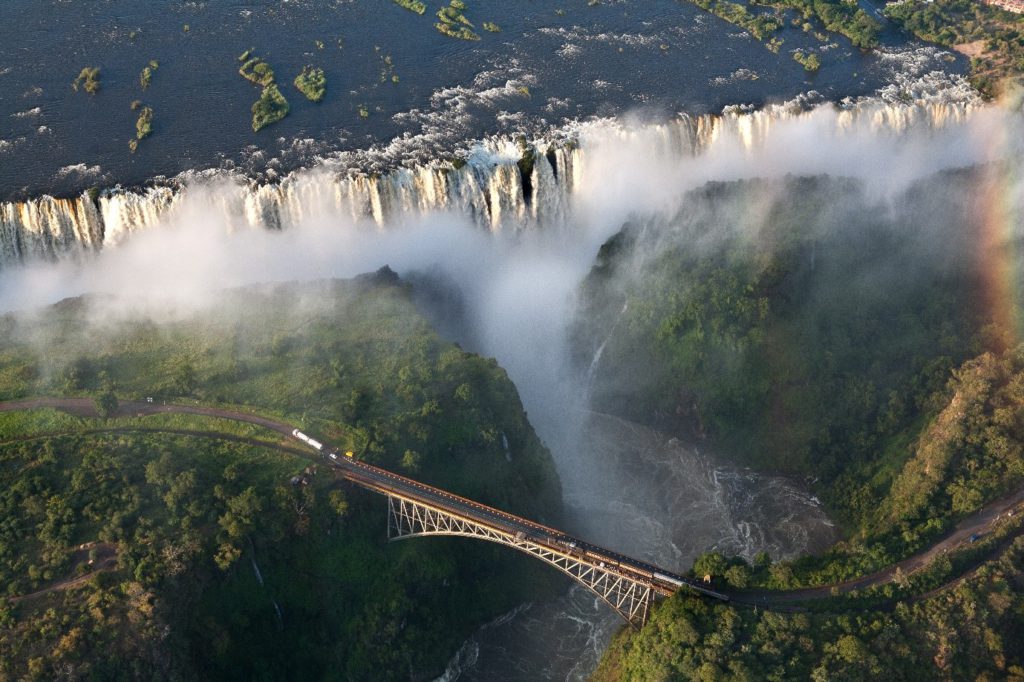
The bridge, composed of steel, measures 198 metres (650 ft) in length, with its principal arch extending 156.50 meters (513.5 ft) and rising to a height of 128 metres (420 ft) above the Zambezi River. It comprises a roadway, a railway, and a pedestrian bridge. The Bridge serves as the sole rail connection between Zambia and Zimbabwe, and is one of only three road connections between the two nations.
Due to Rhodes’ desire to expedite the construction of the Cape to Cairo railway, he mandated that the Livingstone to Kalomo line be established prior to the completion of the bridge. A locomotive was transported in sections across the gorge via the temporary electronic cableway utilized for the conveyance of bridge materials. The construction engineers dubbed it the ‘Blondin,’ and it commenced operations on the Zambian side prior to the bridge’s completion.
The railway facilitated the initial surge of tourists to the Falls, and the original Victoria Falls Hotel was established in 1906.
For over 50 years, the bridge served as the primary passage for travelers from Europe and South Africa to Northern Rhodesia, today known as Zambia. Freight trains predominantly transported coal into Zambia and exported copper and timber from the country. Construction of the Victoria Falls Bridge
Age-related maintenance issues of the bridge have historically resulted in traffic limitations. Trains traversed at speeds below walking pace, while vehicles were restricted to 30 tons, requiring larger trucks to undertake a lengthy detour via the Kazungula Ferry or Chirundu Bridge. The weight limit was increased following repairs in 2006. Currently, the bridge accommodates the Victoria Falls Marathon, other adrenaline activities including bungee jumping, the opulent Rovos Rail train, and the Victoria Falls Steam Train, which offers sunset dining experiences.
Throughout the Rhodesian crisis and Bush War, the bridge was often closed. In 1975, the bridge hosted fruitless peace negotiations, during which the parties convened in a rail carriage suspended over the gorge for nine and a half hours. Freight and road services restarted in 1980 and have operated continuously, except for maintenance interruptions.