Scattering cremated human remains
Mosi-oa-Tunya “The Smoke That Thunders” is not just a scenic landmark. It is a living ecosystem, a protected landscape of riverine forests, basalt gorges, floodplains, and wildlife corridors that cradle the Zambian side of Victoria Falls. Because it is both a national park and a UNESCO-recognized natural treasure, any deeply personal act carried out within its boundaries especially something as symbolic as scattering cremated human remains sits at the intersection of grief, culture, ethics, law, and conservation. This article is written for reflection and general education, not as legal advice.
1) Why Mosi-oa-Tunya draws people seeking a “final place” where scattering cremated human remains takes place
There are landscapes that people associate with beginnings cities, homes, hospitals and landscapes that feel like endings, not because they are bleak, but because they are vast enough to hold a lifetime. Victoria Falls is one of those places. On the Zambian side, the Falls are experienced at close range: mist on the skin, thunder in the chest, a sense of scale that makes daily worries feel small.
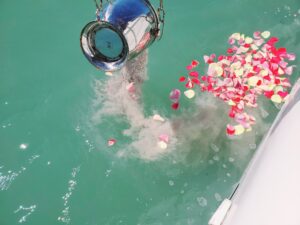
For many families, scattering cremated remains is not about “disappearing” the person; it is about returning them, placing them somewhere that feels enduring, elemental, and beyond private ownership. Water becomes a metaphor for continuity. The gorge becomes a metaphor for time. The roar becomes a kind of hymn that needs no words.
Mosi-oa-Tunya also carries layered meaning because it is both a tourist destination and an ancestral landscape. People visit it from across the world, but local communities have lived with the Falls as part of their spiritual and historical environment for generations. That dual identity global icon and local homeland creates both an opportunity for respectful remembrance and a risk of unintentional harm if visitors treat the park as a private memorial space rather than a protected public trust.
Cremated remains are often called “ashes,” but they are not like fireplace ash. The
2) Understanding what cremated remains are, and what they are not.
y are primarily mineral fragments of bone that have been processed into a fine, sand-like consistency. Chemically, they are dominated by calcium compounds and other stable minerals. They are sterile in the sense that cremation eliminates pathogens; they are not infectious waste.
That said, “safe” does not automatically mean “appropriate everywhere.” In a national park, the question is less about contagion and more about ecology, perception, and precedent.
Ecology: While a small amount of cremated remains is unlikely to cause dramatic ecological disruption, repeated scattering in the same area could alter soil chemistry in micro-sites.
Wildlife interactions: The remains are not food, but animals may investigate unfamiliar scents or containers left behind.
Visitor experience: People come to parks expecting naturalness. Visible memorial items or frequent scattering can create a sense that the landscape is becoming a cemetery rather than a wild place.
Management precedent: Protected areas must consider what happens if one family’s request becomes hundreds.
So the critical question is not simply “Is it harmful?” but “Is it compatible with the purpose of the park, and can it be managed fairly and respectfully?”
3) The legal and regulatory reality: protected areas are not “open permission” spaces
A national park is governed differently from private land, general public land, or even municipal parks. Most countries regulate activities within protected areas through park management authorities. In Zambia, activities in national parks including Mosi-oa-Tunya National Park are typically overseen by the national wildlife and parks management system, and the park has rules aimed at conservation, safety, and visitor order.
Scattering cremated remains is often not explicitly listed on signs, which can lead families to assume it is allowed. But protected areas commonly treat any “depositing” of materials especially human remains as something requiring explicit permission. Even if the material is small, the act may be categorized as: introducing foreign material into a protected ecosystem, conducting a memorial ceremony, or an activity that could affect other visitors.
In practice, families who want to honor someone in Mosi-oa-Tunya should expect that the appropriate approach is to seek formal approval from the park authority before attempting any scattering. This protects the family from legal trouble, and it protects the park from unmanaged practices. It also creates a chance to identify an option that aligns with conservation goals, such as a designated area, time window, or method that avoids sensitive habitats and high-traffic viewpoints.
4) Cultural sensitivity: a sacred landscape is not a blank canvas
Mosi-oa-Tunya is celebrated globally, but it is also interwoven with local cultural meanings. In many African contexts, burial practices, ancestral relationships, and the treatment of the dead are governed by custom and community norms, not only by state regulations.
When an outsider chooses a culturally significant place as a scattering site, even with good intentions, they may unknowingly cross lines. The sound of the Falls can feel like a universal invitation, but cultural sensitivity asks a different question: What does this place mean to the people who have lived alongside it?
A respectful approach includes: acknowledging that the park is part of a local cultural landscape, avoiding loud or disruptive rituals in shared spaces, not leaving objects behind (flowers, plaques, stones, ribbons), and engaging with local guidance when possible.
When families do consult authorities, it can also open the door to culturally appropriate alternatives such as holding a remembrance near, but not inside, ecologically sensitive zones, or choosing a community-approved memorial method.
5) Conservation ethics about scattering cremated human remains
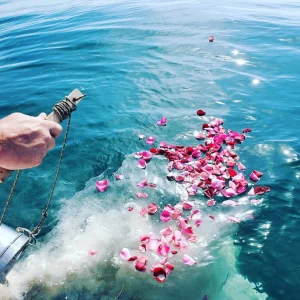
Protected areas exist because natural systems are vulnerable to cumulative impact. One family scattering a small quantity of remains is a tiny event. But parks are shaped by repetition: footsteps become erosion, single litter items become persistent pollution, one off-trail shortcut becomes a network of social trails.
If scattering were to become common at iconic viewpoints on the Zambian side of the Falls, park managers could face: soil compaction and vegetation damage from people stepping off designated paths, increased micro-litter from containers, ribbons, or “biodegradable” items that aren’t truly harmless, conflicts between mourners and tourists, and pressure to formalize memorial areas changing the meaning of the park.
From an ethical standpoint, conservation is not cold or anti-human; it is a form of respect. It says: this place is more than our moment. It must remain healthy for future generations, for wildlife, and for local communities who rely on it.
6) Practical concerns families don’t anticipate
Even when permission is granted (or when people fail to seek it), the reality of scattering at Victoria Falls can be emotionally and logistically complex.
Mist and wind
The spray near the Falls is intense and wind shifts quickly. What feels like a poetic “release into the mist” can become distressing if remains blow back onto clothing or other people. Many families imagine a gentle drift; the Falls often deliver force.
Crowds
Iconic viewpoints are rarely private. A family may arrive expecting a solemn moment and find tour groups taking photos, laughing, and talking loudly snot out of disrespect, but because they are on vacation. The family may then feel anger or regret.
Safety and restricted areas
The most dramatic edges and gorge views are often restricted for safety. Attempting to find a “perfect spot” can lead to risky behavior or rule-breaking exactly what park authorities are trying to prevent.
Containers and “biodegradable urns”
Some people bring biodegradable urns or scatter tubes. Even biodegradable items can take time to break down and may be inappropriate to leave behind. In many protected areas, leaving any container is treated as littering.
Emotional aftermath
Scattering is sometimes portrayed as closure, but grief is not so tidy. Some families later feel pain because there is no grave to visit. Others feel relief because the place itself becomes the memorial. It is worth reflecting on what kind of remembrance your family will need in five years—not only on the day of scattering.
7) A responsible, park-respecting approach concerning scattering cremated human remains
If someone is considering scattering remains in Mosi-oa-Tunya National Park, responsibility begins long before travel. The most respectful pathway usually looks like this:
Contact the park authority directly and explain what you hope to do. Ask whether scattering is permitted, and if so, under what conditions.
Be open to alternatives. The answer may be no, or it may involve designated areas or restrictions you didn’t expect.
Plan for privacy in ways that do not disrupt others. This might mean choosing a quieter time, a brief moment, or a location away from crowded viewpoints subject to whatever the park allows.
Leave no trace. A protected area is not the place for memorial plaques, engraved stones, wreaths, or repeated deposits of items meant to “stay.”
Consider symbolic acts that don’t involve depositing remains. Some families find meaning in a spoken tribute, a small donation to conservation, or a remembrance outside the park boundary where rules are different. This approach honors both the deceased and the living landscape.
8) Alternatives that can still feel deeply connected to the Falls
Sometimes the most loving choice is not scattering inside the park at all, but creating a memorial practice that connects to Mosi-oa-Tunya without adding impact.
A remembrance visits: A family gathering at a viewpoint, with a spoken tribute, can be as powerful as scattering.
Conservation support: Donations to wildlife protection, anti-poaching initiatives, or habitat restoration can transform grief into stewardship.
A memorial outside protected boundaries: In some cases, families choose private land or permitted river access areas outside strict park zones, where rules and ecological sensitivity diffr.
Keepsake practices: Some families divide remains, keeping a portion for a home memorial while honoring the person at the Falls through ceremony rather than scattering.
These alternatives do not diminish the person’s connection to the place; they can strengthen it by aligning memory with protection.
9) The deeper question: what does it mean to “belong” to a place?
Wanting to rest in Mosi-oa-Tunya is often a claim of love: “This place changed them. They felt alive here.” But protected landscapes invite a humbler form of belonging. They remind us that we are visitors temporary, fragile while the river continues, the forest regrows, and animals follow routes older than our maps.
Scattering remains can be a beautiful gesture when done lawfully and respectfully. Yet it becomes most meaningful when it is not an act of possession, but an act of release.
In a national park, love must be compatible with restraint.
Conclusion
Scattering cremated human remains within Mosi-oa-Tunya National Park on the Zambian side of Victoria Falls is a profoundly emotional idea, one that speaks to awe, memory, and the desire to merge a human life with a landscape that feels eternal. But because this place is protected, shared, and ecologically sensitive, the act cannot be treated as purely private. It requires lawful permission, cultural awareness, and a conservation ethic strong enough to hold grief without turning the park into a repository of personal rituals.